
The Potential of LLM-Based AI Chatbots as a Supporting Tool for RSM Analysis in Biodegumming
DOI:
https://doi.org/10.33292/ost.v6i1.167Keywords:
Artificial Intelligence, Biodegumming, ChatBot, RSMAbstract
ackground: The development of optimization models in the biotechnology industry, particularly for the biodegumming of bast fiber plants, requires statistical approaches to determine optimal conditions, and Response Surface Methodology (RSM) is one of the most frequently applied models. However, conventional software such as RStudio is complex for beginners, so supporting tools are needed to assist data interpretation.
Aims: This study aimed to evaluate the capability of generative artificial intelligence (AI) chatbots, namely OpenAI ChatGPT (GPT-5.2) and Google Gemini (Gemini 3 Flash), in interpreting RSM data.
Methods: A qualitative–quantitative approach with a descriptive comparative analysis was employed. Secondary data from 35 experimental runs with two independent factors, previously analyzed by RSM in RStudio, were used. The R² values, model significance, and lack-of-fit status generated by the AI models were compared with the deterministic outputs of RStudio (regression coefficients, ANOVA table, R², and lack-of-fit test).
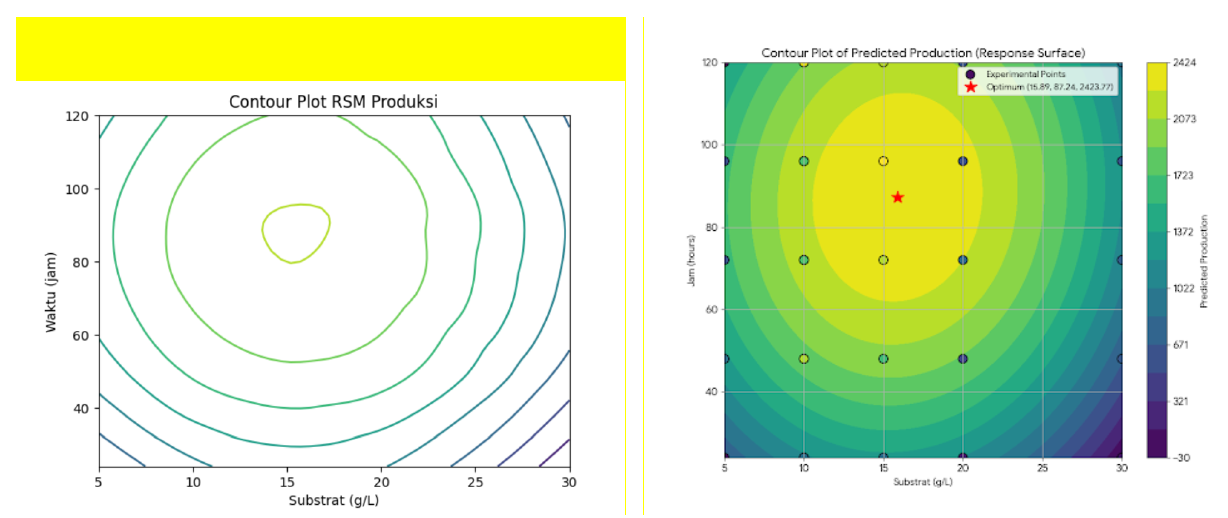
Result: Both AI models were able to identify the model structure and general response patterns, and their R² values (43.6–44.6%) were close to that of RStudio (44.4%); however, numerical differences remained, particularly in the predicted optimum conditions. The effectiveness of the interpretation was strongly influenced by the structure of the prompt.
Conclusion: Both AI models have the potential to serve as tools for interpreting RSM data, but verification with conventional statistical software remains necessary because of their limitations in performing regression calculations.
References
Akinyemi, B., Buraimoh, O., Ogunrinde, O., & Amund, O. (2017). Pectinase production by Bacillus and Paenibacillus sp. isolated from decomposing wood residues in the Lagos Lagoon. Journal of Tropical Life Science, 7(3), 204–207. https://doi.org/10.11594/jtls.07.03.03
Atlas, R. M. (2010). Handbook of microbiological media. Boca Raton, FL: CRC Press.
Balaji, K., Lokesha, A., G., C., & Pushpa, H. M. (2024). Optimizing prompt length and specificity for enhanced AI chatbot responses. International Journal of Current Science Research and Review, 7(9). https://doi.org/10.47191/ijcsrr/V7-i9-61
Chiliveri, S. R., Koti, S., & Linga, V. R. (2016). Retting and degumming of natural fibers by pectinolytic enzymes produced from Bacillus tequilensis SV11-UV37 using solid state fermentation. SpringerPlus, 5(1). https://doi.org/10.1186/s40064-016-2173-x
Chowdhury, T. I., Jubayer, F., Uddin, B., & Aziz, G. (2017). Production and characterization of pectinase enzyme from Rhizopus oryzae. Potravinarstvo Slovak Journal of Food Sciences, 11(1), 641–651. https://doi.org/10.5219/656
Duan, S., Feng, X., Cheng, L., Peng, Y., Zheng, K., & Liu, Z. (2016). Bio-degumming technology of jute bast by Pectobacterium sp. DCE-01. AMB Express, 6(1). https://doi.org/10.1186/s13568-016-0255-3
Duan, S., Xu, B., Cheng, L., Feng, X., Yang, Q., Zheng, K., Gao, M., & Peng, Y. (2021). Bacterial strain for bast fiber crops degumming and its bio-degumming technique. https://doi.org/10.21203/rs.3.rs-483427/v1
Dwivedi, Y. K., Kshetri, N., Hughes, L., Slade, E. L., Jeyaraj, A., Kar, A. K., Baabdullah, A. M., et al. (2023). “So what if ChatGPT wrote it?” Multidisciplinary perspectives on opportunities, challenges and implications of generative conversational AI for research, practice and policy. International Journal of Information Management, 71. https://doi.org/10.1016/j.ijinfomgt.2023.102642
Glickman, M., & Sharot, T. (2025). How human–AI feedback loops alter human perceptual, emotional and social judgements. Nature Human Behaviour, 9(2), 345–359. https://doi.org/10.1038/s41562-024-02077-2
Gonçalves, D. B., Teixeira, J. A., Bazzolli, D. M. S., de Queiroz, M. V., & de Araújo, E. F. (2012). Use of response surface methodology to optimize production of pectinases by recombinant Penicillium griseoroseum T20. Biocatalysis and Agricultural Biotechnology, 1(2), 140–146. https://doi.org/10.1016/j.bcab.2011.09.002
Hackenberger, B. K. (2020). R software: Unfriendly but probably the best. Croatian Medical Journal, 61(1), 66–68. https://doi.org/10.3325/cmj.2020.61.66
Horikoshi, S., Yamazaki, S., Arai, Y., Sakemi, D., Yoshizawa-Fujita, M., & Serpone, N. (2021). Synthesis of recyclable magnetic cellulose nanofibers from ionic liquids for practical applications in separation science. Journal of Oleo Science, 70(5), 737–743. https://doi.org/10.5650/jos.ess21087
Imran, M., & Almusharraf, N. (2024). Google Gemini as a next generation AI educational tool: A review of emerging educational technology. Smart Learning Environments, 11(1). https://doi.org/10.1186/s40561-024-00310-z
Labadze, L., Grigolia, M., & Machaidze, L. (2023). Role of AI chatbots in education: Systematic literature review. International Journal of Educational Technology in Higher Education, 20(1). https://doi.org/10.1186/s41239-023-00426-1
Lamidi, S., Olaleye, N., Bankole, Y., Obalola, A., Aribike, E., & Adigun, I. (2023). Applications of response surface methodology (RSM) in product design, development, and process optimization. In Response surface methodology – Research advances and applications. IntechOpen. https://doi.org/10.5772/intechopen.106763
Liu, P., Yuan, W., Fu, J., Jiang, Z., Hayashi, H., & Neubig, G. (2023). Pre-train, prompt, and predict: A systematic survey of prompting methods in natural language processing. ACM Computing Surveys, 55(9). https://doi.org/10.1145/3560815
Montgomery, D. C. (2017). Design and analysis of experiments. John Wiley & Sons.
Obomighie, I., Prentice, I. J., Lewin-Jones, P., Bachtiger, F., Ramsay, N., Kishi-Itakura, C., Goldberg, M. W., et al. (2025). Understanding pectin cross-linking in plant cell walls. Communications Biology, 8(1). https://doi.org/10.1038/s42003-025-07495-0
Oumer, O. J. (2017). Pectinase: Substrate, production and their biotechnological applications. International Journal of Environment, Agriculture and Biotechnology, 2(3), 1007–1014.
Park, J., & Choo, S. (2024). Generative AI prompt engineering for educators: Practical strategies. Journal of Special Education Technology. https://doi.org/10.1177/01626434241298954
Przybek, A. (2025). The role of natural fibers in the building industry—The perspective of sustainable development. Materials, 18(16). https://doi.org/10.3390/ma18163803
Retzlaff, C. O., Das, S., Wayllace, C., Mousavi, P., Afshari, M., Yang, T., Saranti, A., et al. (2024). Human-in-the-loop reinforcement learning: A survey and position on requirements, challenges, and opportunities. Journal of Artificial Intelligence Research, 79.
Subash, M. C., & Muthiah, P. (2021). Eco-friendly degumming of natural fibers for textile applications: A comprehensive review. Cleaner Engineering and Technology, 5. https://doi.org/10.1016/j.clet.2021.100304
Veza, I., Spraggon, M., Fattah, I. M. R., & Idris, M. (2023). Response surface methodology (RSM) for optimizing engine performance and emissions fueled with biofuel: Review of RSM for sustainability energy transition. Results in Engineering, 18. https://doi.org/10.1016/j.rineng.2023.101213
Wan, X., Sun, R., Dai, H., Ar?k, S. Ö., Pfister, T., Google Cloud, AI Research, & Google DeepMind. (2023). Better zero-shot reasoning with self-adaptive prompting.
Wulandari, A. P., Purba, J. R., Irawan, B., Masruchin, N., Ismayanti, M., & Gustiani, R. S. (2021). Effect of harvesting age of plant and pectinolytic selected-fungi in biodegumming ramie performance. Heliyon, 7(11). https://doi.org/10.1016/j.heliyon.2021.e08392
Downloads
Published
How to Cite
Issue
Section
License
Copyright (c) 2026 Nurul Nisa Primadiaty, Alnadia Yusriya Hibatullah

This work is licensed under a Creative Commons Attribution-ShareAlike 4.0 International License.


